The world’s powder keg: a deep analysis with Assoc. Prof. Ph.D. Alba Popescu on Africa and the stakes of global resources – Part II

There is a metaphysical sadness in the image of Africa as a bloody Cornucopia of the modern times, an area where the subsoil teems with gold and diamonds, but the “immune system” of states was compromised from its very infancy. As Associate Professor Alba Popescu observes, the rectilinear borders, drawn with a ruler in European salons, created fragile state entities, born in the test tube of foreign interests, transforming capitals into simple drainage points for wealth toward metropolises. It is painful to acknowledge that, while African gold built the maritime empires of modernity, local populations remained suspended between a technologized neo-medievalism and a dehumanizing poverty.
This world, caught in a geopolitical pincer between Eurasia and the Atlantic, still bears the deep marks of an exploitation that exceeded the economic sphere, mutilating the collective mental state. The paradoxical feeling of the African toward the former master – a mixture of rejecting the aggressor and a desire to follow their example, to attend their schools, and to adopt their lifestyle – perfectly describes the tragedy of a fragmented identity. In this context, “the cow was milked to exhaustion”, and the promises of civilization proved to be, most often, merely instruments of domination.


Romania occupies a special place in this geography of nostalgia, remembered as the partner that, unlike the West, “also nourished” the young African states in past decades. However, ignorance and post-December political decisions have deprived us of this huge potential for cultural and diplomatic influence. We abandoned an inestimable capital of influence, leaving the space for China and Russia to manage an African dominion that signals increasingly clearly toward the multipolar bloc, while Europe remains an aging “chessboard” marked by ideological conflicts and cultural tensions.
Africa’s destiny warns us that wealth unsupported by a national vision and defense mechanisms turns into a curse. It is the harsh lesson of the “Cornucopia” which, in the absence of a national consciousness among leaders, becomes a theater for divide et impera. If Europe and Romania do not reconsolidate their strategic independence and cultural-civilizational bond, they will end up watching helplessly as the “world’s clock” moves definitively toward the East, in a global reconfiguration where geography remains the only silent constant.
In this complex landscape, Romania maintains its benchmarks of excellence through prestigious institutions such as the National Defense College, a true sanctuary of enduring values and unconditional devotion, where the sacred duty toward the country intertwines harmoniously with the rigor of enlightened minds. More than a simple academic institution, this college remains an elite space where, under the guidance of exceptional professors, such as Dr. Alba Iulia Popescu, characters are formed and strategic visions are polished to protect the destiny of our nation. The presence of the professor at the department of this institution guarantees both a rigorous transmission of geopolitical knowledge and the instilling of that unquenched flame of authentic patriotism that transforms responsibility into honor and knowledge into the most precious shield of national dignity.
Thus, elite schools in Romania, when animated by personalities with a vast culture and a deep understanding of the world’s “pivot zones”, represent essential elements in the fight against the ideological inertia that has gripped the continent. Through its teachers, the National Defense College succeeds in offering generations of leaders the vision necessary to face the storms of the present, reminding us that strategic independence is not won only through treaties, but through the intellectual and moral strength of those who have the courage to understand and defend the national interest in a world in full paradigm shift.
Ciprian Demeter: Africa is often described either as a continent of opportunities or one of permanent crises. Reality is much more complex and diverse than these simplifying labels. In which direction is Africa headed geopolitically in the coming decades?
Alba Popescu: If the ancient Greeks had explored Africa, they would have described Midas as the king of the “black continent”, so full of gold and diamonds is its subsoil. That is why, as soon as colonization began, European metropolises competed in what would become, in the 19th century, the “scramble for Africa”. If I were to make a historical comparison, I could say that Dacian gold saved Rome, while African gold built the maritime empires of the modern era. These were empires that were hardly civilizing, because the legacy of Rome was not transmitted to the maritime vein, which remained tributary to Phoenician, Canaanite, and Carthaginian traditions. Consequently, the colonizers sought to enrich themselves, without being too concerned about the living conditions of the locals turned into slaves and servants.
Hundreds of years of oppression and exploitation could not fail to leave deep marks on the African collective mental state and on the way the European civilizational model was perceived on the continent. More specifically, although they eventually accepted the Weberian state drawn with a ruler by colonists, between November 1884 and February 1885, at the Berlin Conference (Kongokonferenz), and although they formally adopted the monotheistic religions of the “masters”, Africans remained tributary to their own customs, beliefs, and societal and political models.
Therefore, the African states, conceived in the crucible of European expansionism and supremacy, were born weak, with a compromised “immune system”, like premature infants. Their rectilinear borders either divided ethnicities or brought together ethnic groups in conflict. Their eccentric capitals, located in ports or on caravan routes, exercised only the colonial function of draining riches to metropolises, without fulfilling their fundamental role as Mittelpunkt – the pulsating nucleus of the state that holds the national territory together through culture and civilization. Moreover, the African states themselves were born before the corresponding nations and national ideas existed. These dysfunctions occurred within traditionally tribal, clanocratic, patriarchal, and hierarchical societies.
This is why the world of Africa has remained suspended between Westphalian modernity and a kind of neo-medievalism that combines access to technology with extreme poverty and absolute underdevelopment. In such a world, it is easy to stir up ethnic and confessional pride, to whet the hunger for power and the greed of local leaders lacking national consciousness, and to apply the ancient strategy of divide et impera. That is why, after declaring independence in the second half of the 20th century, African states became victims of the wrongdoings of former metropolises, ending in horrific carnages, such as the one in Rwanda in 1994.
Over this state of affairs, the events of 1979 were superimposed – the Islamic Revolution in Iran, the siege of the Grand Mosque in Mecca, and the Soviet invasion of Afghanistan – which shifted the attention of the American military-industrial complex toward securing its Israeli bridgehead, geopolitically marginalizing Africa. Against this background, the gradual withdrawal of America from the region took place, the greatest geopolitical error of the Western hegemon. An error stemming from the lack of geopolitical culture among decision-makers, already tributary to cultural and academic Trotskyism that labeled geopolitics as politically incorrect knowledge.
Why do I say this? Because Africa means, above all, the southern pivot zone. That is, a space with inestimable geostrategic value, conferred by its centrality on the world map, and the immensity of its territory and resources. An enormous “Cornucopia”, touched not only by the god-cursed hand of the greedy Midas, who turned everything he touched into gold. A “Cornucopia” from which overflow platinum-group metals and other strategic ores, silver, diamonds, and precious stones, iron and non-ferrous metals, hydrocarbons, uranium, coal, precious wood, and so on; a space situated on the southern coast of Europe, which, together with the other pivot zone of the Eastern Hemisphere located in the north, in Eurasia, in the world of Russia, catches the small continent in a geographic and geopolitical “pincer”. It is a space that can project force into the Atlantic and the Indian Ocean, toward Eurasia, and toward South America, and which, for a few decades until 1990, was disputed between its former metropolises and the Soviet bloc, in which Romania distinguished itself as a major regional player.
After 1990, the former Soviet bloc was replaced by China, which transformed Sub-Saharan Africa into a mega-dominion through the current level of indebtedness and dependency of African states on Chinese capital. And currently, against the background of the geopolitical weakness of former metropolises, their place is beginning to be occupied by the Russian Federation, which is becoming increasingly present in the north of the continent, the territorial limit between the spheres of influence of the two eastern powers being the Sahel.
The success of the two powers from the East also has explanations related to African psychology. Subjected to centuries of atrocious exploitation – and it is sufficient to mention the massacre of Congolese on the rubber plantations of King Leopold II of Belgium – Africans developed a paradoxical feeling toward their former masters. On the one hand, they reject them, considering them aggressors and exploiters, and on the other, they seek to resemble them, imitating their clothing and way of life, continuing to attend their schools and universities, or buying their noble titles along with the associated properties. All this while asserting their pride in being African more and more determinedly through pan-Africanism and négritude, and demanding the erasing from history of former colonists through the assimilation of woke discourse – Black Lives Matter.
However, the same does not happen toward the former Eastern bloc. It is known that the USSR and its satellite states, among which Communist Romania stands out, actively supported the process of decolonization and the consolidation of the young African states. Subsequently, China, unlike the West, continued this strategy. Even if, essentially, it is about spheres of influence, access to resources, dominance, and control, the philosophy behind this strategy differs fundamentally. While the West “milked the cow” to exhaustion, offering it portions of beatings instead of fodder, the Soviets, and later the Chinese, also gave it food to eat. This would be, in terms everyone can understand, the difference in approach.
A historical legacy that explains the sympathy China enjoys today among Africans, which exceeds an average of 50% of the population and in some cases, such as Burkina Faso, Mali, and Niger, reaches 80%. A sympathy that Romania still enjoys, in its capacity as a former partner of African states in the 1970s and 1980s – a capital of influence of which it deprived itself through post-December anti-national political decisions, which canceled its soft-power potential. Romania’s only real power potential!
Why did I provide this summary of Africa’s colonial history? To offer you a framework for understanding the geopolitical direction in which I believe the continent’s states are headed in the coming decades. It is a direction increasingly distant from the Collective West and closer to the Multipolar Block, a fact already demonstrated by Gabon, Madagascar, and the Sahel-corridor of coups orchestrated by the Russian Federation and China, which removed pro-Western regimes, particularly those close to France (see the map in Fig. 1).
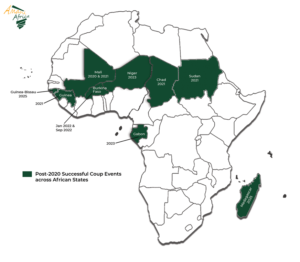
Fig. 1
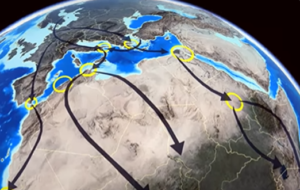
Fig. 2
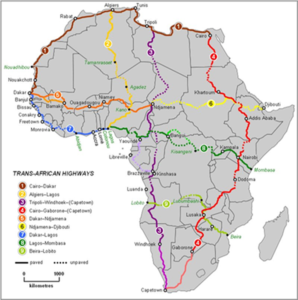
Fig. 3
If we superimpose this corridor over the Western strategic plan for Euro-African interconnection (see the map in Fig. 2), which was intended to link the Arctic space to the Mediterranean and from there to the African space through three alternative routes (see the map in Fig. 3) – Tunisia, Libya, and Egypt, down to South Africa – we fully understand the geopolitical, geostrategic, and geo-economic impact of this massive paradigm shift. And if we also add the energy corridors that were supposed to bring hydrocarbons from the Gulf of Benin to Europe, passing exactly through this pro-Chinese and pro-Russian Sahel-corridor, the picture becomes even clearer.
Consequently, from my point of view, at least in the short and medium term, Africa will “signal” toward the multipolar block. North Africa will slide predominantly toward the Russian sphere of influence, while Sub-Saharan Africa will continue its process of transformation into the “second China”, especially against the backdrop of the Global Civilization Initiative launched by Beijing in 2023. How well will the Africans fare? That remains to be seen. Because there, against the background of the non-existence of strong national ideas, rebel groups and dissatisfied local leaders can appear at any time, ready to overturn social peace if they receive help from outside. Look at what is happening in Somalia, where clans of the same ethnicity and confession are warring with each other. Or the conflict in Sudan. Or the one in DR Congo.
Ciprian Demeter: China’s presence in Africa has grown significantly through investments in infrastructure, resources, and strategic projects. This influence triggers different reactions on the international stage. Is China’s involvement in Africa a real development partnership or a new form of geopolitical dependency?
Alba Popescu: I know it sounds cynical, but in geopolitics, there is no generosity, for the simple reason that relations between states are dictated by interests. Interests that oscillate between two extremes: on one side, the need for survival, and on the other, global hegemonic ambitions. Consequently, any “partnership” is the result of an agreement in which both parties offer something and receive something else in return. For a partnership to be equitable, there must be a balance between the demands and offers of the two parties, and it must conclude with substantial gains for each of them. In this case, an equitable partnership would mean that in exchange for the riches of the soil and subsoil and, eventually, their geostrategic position, African states receive peace and, as much as possible, prosperity, through the construction of energy, goods, people, and data transport infrastructures, sanitation, education, and medical assistance infrastructures. That is, those necessary and sufficient conditions to emerge from the state of underdevelopment in which they have struggled for hundreds of years.
Of course, the poverty and underdevelopment of African states is also the result of the phenomenal corruption of their political class, which consolidated a plutocracy revealed by the revoltingly high values of the Gini coefficient. Values that demonstrate that African poverty is essentially distributive. In other words, according to these values, 5% of Africa’s population holds 95% of its wealth, which means a polarization of African society between extreme, dehumanizing poverty and disgusting opulence.
Therefore, the development partnership between China and African states, if it exists – and I tend to believe so – automatically passes through the Caudine Forks of African corruption and plutocracy. What remains of it is seen in the volume of Chinese investments on the continent, on the order of hundreds of billions of dollars, presented during the triennial meetings of the Forum on China-Africa Cooperation (FOCAC). Why do I tend to believe that such a partnership exists? Because this is the philosophy of China’s Grand Geopolitical Strategy in Africa and everywhere, expressed through its series of hegemonic initiatives. It is a Grand Strategy tributary to the principle of wu-wei (effortless action), Asian patience, and the game of Go. A strategy concentrated, in the first phase, on geo-economic seduction through the granting of preferential loans, industrial investments, and the construction of transport and storage infrastructures, followed by political influence and, finally, military presence (see the map in Fig. 4). In fact, if you follow the succession of Beijing’s global hegemonic masterplans, you notice that it began with the geo-economic Belt and Road Initiative (BRI) addressed to Eurasia and Africa, continued with the Global Civilization Initiative, in fact an expansion of the first masterplan to the level of the Global South, and with the Global Security Initiative, addressed to the ”Silk Block”, culminating, relatively recently, with the Global Governance Initiative, intended to cement the Chinese sphere of influence of the Community of a Shared Future for Mankind. I believe that the Chinese strategy, even if it essentially pursues the same hegemonic interests as those of the Western metropolises, has real chances of success because it produces geopolitical dependency through seduction rather than through force. That is, it “milks the cow”, but also gives it something to eat.
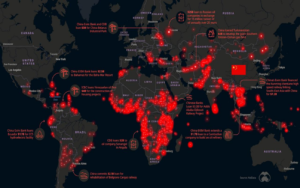
Fig. 4
Ciprian Demeter: In parallel with China, Russia has intensified its presence in Africa, especially in unstable areas, through security contracts and military support. What is Russia pursuing in Africa and how sustainable is this strategy in the long term?
Alba Popescu: In Africa, the Russian Federation inherited not only the debts of African states to the USSR but also the positive history of the empire in the region. Do not forget that decolonization served the interests of the hegemons born from the ruins of the two world wars. More specifically, decolonization dismantled what remained of European imperialism after the disappearance, in a first stage, of the Second Reich and the Habsburg, Tsarist, and Ottoman empires. Practically, decolonization amputated a large part of the overseas empires of France, the British Crown, Portugal, Belgium, Spain, and the Netherlands – metropolises emptied of power at the end of the Second World War and forced to align with the American hegemon. A hegemon that sought to consolidate its dominance over its new European vassals not only through the Bretton Woods system but also through the decommissioning of their sources of power represented by colonies.
An interest also pursued by the other, Soviet hegemon, which wanted to extend its sphere of influence as far as possible from its own borders, in Africa, Asia, and South America, and to defeat capitalist “rot” with the “strong arms” of a peasantry and proletariat animated by Trotskyism. Consequently, in Africa, the USSR supported national liberation movements and, subsequently, the state-building process of the new African political actors – states that did not become communist but developed a specific socialism, of African origin, predominantly economic, which merged the tradition of extended families with Marxist precepts.
Therefore, the withdrawal of the USSR and, later, the Russian Federation from Africa was by no means the result of any coup or the hostility of the African population, but a unilateral geopolitical decision of Moscow in the 1990s, against the background of losing the Cold War to the American competitor and the need to rebuild its hegemonic power. Under these conditions, the recent return of Russia to the African ”cards” occurred naturally, even if its former sphere of influence had been, for the most part, taken over by China. It began in the period 2008-2012, through the cancellation of 36 billion US dollars from the historical debt of African states to the USSR, transferred to the Russian Federation. It continued in 2009 with the establishment of the Coordinating Committee for Economic Cooperation with African States and, in 2011, the Russian Agency for Export Credit and Investment Insurance in Markets with Political and Military Risk, and culminated in 2019 with the Russia-Africa Economic and Humanitarian Forum. In parallel, throughout this interval, Russia became a security provider through peacekeeping troops under the UN aegis in states such as DR Congo, Ivory Coast, Liberia, Ethiopia, Eritrea, Sudan, South Sudan, and Western Sahara. I remember an observation by Peter J. Pham, from the Atlantic Council, who said that in 2014, the Russian Federation had “more troops in the blue helmets in Sub-Saharan Africa than the USA, UK, and France combined”. Subsequently, its military presence was completed by the Wagner Group, which before acting in Ukraine, had Africa as its main theater of operations, especially the Central African Republic, Mali, Niger, Burkina Faso, Algeria, Libya, Sudan, Eritrea, Mozambique, and Madagascar – states where it also ran propaganda campaigns, some responsible for the success of the coups after 2021.
Currently, Russia forms a power binomial with China, in direct confrontation with the Collective West – a complementary binomial of the hard-power type, with a military component still predominantly Russian and an economic one predominantly Chinese. As I said in my first interview with you, the attack on Iran by the USA-Israel tandem rebalanced the power relationship between Russia and China, which had been deeply imbalanced in favor of China, especially in the context of the war in Ukraine. Practically, against the background of the blockage of the Strait of Hormuz, Russian hydrocarbons shifted the center of gravity of the Asian, Multipolar, Silk Block, or whatever you want to call it. From a proxy of China, as it had become after 2022, Moscow has become an equal partner with Beijing, involved in the common effort to overturn the post-war Anglo-Saxon order.
This state of affairs is also reflected in Africa, where the Russian Federation seems to concentrate its dominance over the north of the continent, while Sub-Saharan Africa enters China’s “portfolio”. How sustainable is Russia’s strategy in the long term? I refrain from giving geopolitical verdicts for such an interval of time. Given the strategy applied and the positive history, I tend to believe that Russia’s return to African affairs could be a successful one. But … we must not overlook the fact that the world changes, treaties change, as do alliances and, implicitly, interests. What does not change is only geography, and even here changes can occur. Therefore, what today can be the territory of an unshakable alliance, tomorrow can transform into a theater of operations between former allies. China’s hegemonic emergence cannot fail to worry Russia. The fact that leaders in Beijing declared China a Near-Arctic state and that through the Polar Silk Road they completely hem in Russia cannot go unnoticed by formidable Russian geopoliticians. Consequently, the future can bring great changes. A China transformed into a global technological hegemon could majorly reconfigure the alliance and power network of the future, and today’s enemies could transform into tomorrow’s allies and vice-versa. And this is because in geopolitics nothing is eternal, nothing is static, everything moves and transforms. Whether we like it or not.
Ciprian Demeter: Africa is facing an unprecedented demographic explosion that can become either a major advantage or a source of instability. Managing this phenomenon is essential. How can Africa’s demographics influence the global balance of power?
Alba Popescu: Indeed, as old as the African continent is, its population is just as young. If we look at Africa’s demographic statistics, we find that its population has grown to 1.55 billion inhabitants, and the natural increase exceeds 2.2%, which means that nearly 20% of the planet’s population lives on this continent. A continent situated off the coast of an aging Europe that is in full process of depopulation, which naturally places it within the radius of the concentric effects of African geopolitical dynamics.
If we look at the geostrategic triangle of the Eastern Hemisphere (see the map in Fig. 5), which I also spoke to you about in the first part of this interview, we find that the base of this isosceles triangle crosses overpopulated areas, some developing, others in conflict.
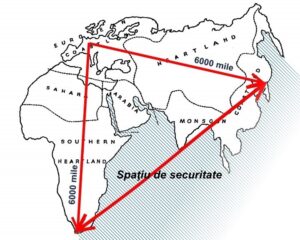
We also observe how the left side of the triangle crosses Africa, a space of crises and conflicts, of poverty and underdevelopment, and its peak is located in our Europe. A rich but aging peak, consumed by Trotskyism and the ambition to become the great normative power of the Universe, in the name of which it has annihilated its anti-illegal cross-border migration antibodies. Migration that occurs naturally, inherently, by virtue of the dialectic of this geostrategic triangle, which brings the poor and numerous populations from the base of the triangle toward the autolytic European continent.
It is a Europe that, like Racine’s hero, is caught between the desperate desire to return to its former brilliance and the helplessness arising from its current geopolitical status. We are talking about an ungrateful status of a “chessboard” on which the three “big ones” play and kibitz: the USA, Russia, and China. A status into which Europe itself has thrown itself, through its endless “civil wars”, as Huntington called post-Westphalian European wars. A status that is now being consolidated against the backdrop of its demographic collapse and its transformation into a veritable demographic “sponge” for African and Asian populations in search of prosperity. But migration, and especially illegal cross-border migration, comes with a whole train of consequences, from political to social, from security to economic.
Perhaps the most serious political consequence of illegal cross-border migration is the rise of Euroscepticism. You see, German Chancellor Merkel’s terrible decision to suspend the Dublin Agreements and the lack of reaction from the European institutions of the moment triggered a chain of events that tested the solidity of the European construction. Because then there was a return to the paradigm of national states, borders were closed, and barbed wire fences were erected. Moreover, European policies, increasingly ideological and tributary to a kind of normative exceptionalism meant to replace European exceptionalism arising from the civilizational tradition of Rome, blocked the defense mechanisms against this phenomenon. Thus, illegal migrants became refugees in politically correct discourse, illegal migration was redefined as irregular migration, European borders became porous, easy to cross, and Europe found itself having to manage migration waves never seen before. The political cost of these decisions is translated today into the percentage of Eurosceptic – people who no longer believe in the advantages offered by a Europe led from Brussels. A growing percentage, against the backdrop of the failure, during the pandemic, of the second test of the solidity of the European construction and the increasing rift between political decisions and the will of the European electorate. Ultimately, we must understand that ignoring the popular will under the pretext of rejecting populism ends up turning against the establishment through the right-wing or left-wing radicalization of public opinion. Migration has been militarily instrumented and transformed into a vector of hybrid war or political blackmail. Look at the border between Poland and Belarus, where African and Asian migrants are transported by the authorities in Minsk and encouraged to cross into the neighboring country. Or remember Turkey’s game toward Europe in the context of the migration generated by the “Arab Spring”, that wave of Hanabillah Islamist anarchy created during the Obama administration in North Africa and the Middle East.
Then there are the economic consequences of this decision, which are superimposed on the costs of supporting Ukraine’s war efforts and the prolonged crisis in the Middle East. All of this economically burdens the European taxpayer and pushes them toward radicalization and Euroscepticism.
To these is added the civilizational consequence of migration, through heterogeneity and the gradual loss of European identity against the backdrop of the continent’s catastrophic demographics. For now, these effects are at their beginning, but they will become visible in the next 20-30 years, when the proportion of native Europeans will decrease in favor of migrants. Practically, we are witnessing an insidious form of transformation of Europe into a different kind of “melting pot of nations”, one meant to erase European identity and not to create it, as happened in the case of America. A melting pot in which there will be major rifts and conflicts, because these replacement populations come with their own religions and customs, some based on ultra-conservative anti-Christian dogmas, meant to forcibly convert native populations and radically change their way of life. Consequently, the future of Europe is not a bright one, as it is prefigured at present, against the backdrop of demographic collapse and this ideology meant to destroy its fiber and civilizational heritage in the name of an imported exceptionalism. An exceptionalism that serves the hegemonic objective of maintaining Europe in the “gray zone” of great geopolitical games, in an unfortunate status of a “chessboard” on which others play.
Of course, there are also security consequences of illegal migration coming from Africa and South Asia. Starting with dangers to public health and continuing with those of public safety. It is enough to remember that recruitment pools and migration routes are controlled by Mafia-type structures and terrorist organizations coordinated by state or non-state players, who could use migrants to put pressure on European recipient states. Imagine the havoc that could be caused by a few illegal migrants infected with Ebola or another hemorrhagic fever, still asymptomatic, in train stations, airports, or any crowded public place. It is a reality that the “useful idiots” of the “new crucible of Europe” omit from their propagandistic discourse.
Therefore, we are talking about a perfidious geopolitical process, meant to bring Europe to its knees to the level of its passing into memory and to force it to choose between remaining a perpetual promontory controlled by Washington or a peninsula controlled by Moscow and/or Beijing – a process that corroborates the growing demographics of the poor areas of the Eastern Hemisphere with the stoking of conflicts and regional instability, meant to add waves of refugees and amplify the poverty and misery of these human beings. These are people who arrive in Europe, where they begin to feel the effects of uprooting and fill their identity void with a much more pregnant, more radical religious identity, becoming the maneuvering mass for politico-religious networks, such as the global Islamist one. And it is not only this one; there are others as well.
Certainly, growing demographics, against the backdrop of poverty and the inability of African states to manage it administratively, also lead to other forms of exporting insecurity into neighboring spaces. Because not only does illegal cross-border migration hit Europe, but also maritime piracy and robbery at sea. European companies have paid the heaviest price for the pirate attacks in the Gulf of Aden and the Gulf of Benin – piracy developed as a last resort for fishing populations whose waters were infested by companies, Western or otherwise, which either exploited oil without respecting environmental norms or dumped the world’s waste, even radioactive, on the defenseless shores of Africa. Then there is criminality and terrorism, which go hand in hand. If you look at the routes transiting Africa, bringing drugs from South America to Europe, you see how they intersect with areas controlled by terrorist organizations more or less affiliated with the Global Islamist Network (see the map in Fig. 6). But we are not just talking about drug trafficking, but also about trafficking in persons, weapons, counterfeit medicines, etc. All ending up feeding “merchandise” to Mafia-type networks in Europe, the African nucleus being represented by the Nigerian Mafia.
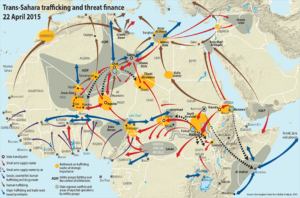
Fig. 6
Surely, you will ask what is to be done? I believe that Africa deserves a different fate than the one served to it by its colonizers, whose descendants are beginning to understand the teachings of Oriental tales about Karma. Another fate, which would involve pacification and investments in development, so that its heavily tried population would no longer be uprooted and could continue to live on the mythical land of the old continent. Surely such an evolution would involve a collaboration of Europe with the Eastern Bloc, a fact inconceivable at present. But we do not know what the future holds, and especially the distant one. In any case, if Africa is not pacified and the current state of affairs continues in the coming decades, Europe will end in a true civilizational collapse!
I also believe that Europe, if it wants to remain in any geopolitical book of the future, must solve four major problems: the demographics of its native population, illegal cross-border migration, its strategic independence, and cultural-civilizational reconsolidation. Demographics are solved through policies to stimulate the birth rate and support the family. Illegal cross-border migration is combated through related policies, including those targeting the granting of citizenship to children born to illegal migrants. Strategic independence, imperatively necessary, targets those military programs meant to develop European defense capabilities. And cultural-civilizational reconsolidation targets the European binder, without which neither unity nor power can exist! And this is represented by Christianity and its Greco-Latin civilizational heritage! Nothing else! Europe is, above all, a civilizational omphalon, which, besides the fact that it ordered the world based on its Westphalian principles, Cartesianism, rationalism, and its Weberian state model, also configured the historical eras of humanity and set the exact time of the geographic and geopolitical world. Consequently, the state of ideological torpor in which the ”continent of lights” has fallen for over 70 years must end if Europeans still want to count in any way in the not-so-distant geopolitical future.
Ciprian Demeter: The conflicts in the Sahel, the Horn of Africa, and Central Africa have a significant regional and international impact, including on European migration and security. Why do international interventions in the stabilization of Africa often fail?
Alba Popescu: Obviously, I had no way of knowing you would ask me this before I answered your previous question, and I am glad we spoke about the link between the destabilization of Africa, illegal cross-border migration, and the security and geopolitical future of Europe. Now it is much easier for me to assert that the current destabilization of Africa is programmed; it is the result of a hegemonic geopolitical game meant to ”touch Africa” and ”bite” Europe. You cannot destroy great powers or global masterplans except from the inside, by annihilating their ”immunity” through toxic ideologies and introducing more and more sources of crisis and conflict, like a lethal virus that paralyzes your lymphocytes and multiplies exponentially.
To this state of affairs is added a fundamental misunderstanding of African society by Westerners. Europeans, who have made a new Bible out of normative exceptionalism, can understand neither the rules nor the rhythms of an ancient society, tributary to ancestral beliefs and local customs. Consequently, they come with their postmodern civilizational model and their negative history in the region and wonder why Africans no longer want them around. This is despite European states being among the major donors within the reconstruction and development programs of African states. This also applies to the Americans. And I always wonder why Romania’s capital of influence is not used in the West’s relationship with African states? Why is such a major geopolitical asset wasted? Out of ignorance? Out of ill will? Out of indolence? I do not know for what reason!
Consequently, international interventions for the stabilization of the ”black continent” fail because the hegemons of this world do not desire this, preferring to maintain Africa in this terrible state of geopolitical marasmus, with failed and collapsed states, with large masses of migrants, refugees, and internally displaced persons, with criminal networks, with terrorism and religious fundamentalism, with food crises and major ecological disasters, in order to seize its riches and keep Europe in a geopolitical checkmate.
Ciprian Demeter: Africa holds critical resources for the economy of the future, including rare minerals essential for green technologies. Will Africa become the center of a new geopolitical race for resources?
Alba Popescu: Africa is already at the center of such a race. Otherwise, how could the sudden American concern for the fate of Nigerian Christians, massacred for years by Islamists from Boko Haram, be explained? Or the Chinese interest in investing in Africa’s ports and transport infrastructures? Or the Russians’ willingness to cancel the historical debts of African states to the USSR? Or the obstinacy with which former metropolises try to remain in the African ”cards”?
And to give you an idea of what kind of riches we are talking about and in what quantity, it is enough to remember that South Africa holds 75% of the global high-concentration manganese reserve, a mineral crucial in the production of steel and alloys; 41.67% of the chromium reserve, a metal used in metallurgy and the chemical industry for its exceptional corrosion resistance; 23.4% of that of vanadium, crucial in the aerospace industry, the production of tools and batteries; 17% of the global fluorspar reserves, widely used in the production of steel, aluminum, and other chemicals due to its property of lowering the melting point; 48% of the global natural diamond reserve (together with Botswana and DR Congo); 95.4% of the global platinum and platinum-group metal reserves (and 73% of world platinum production), present in the manufacturing process of one-fifth of consumer goods, from catalytic converters intended for carbon emission reduction (”environmental metal”), to I.T., the aeronautical industry, etc. Or that in Africa there is 14.5% of the global gold reserve, in countries such as Ghana, Zimbabwe, Tanzania, Guinea, Mali, Burkina Faso, Angola, Zambia. That Niger supplies 14.7% of global uranium production, being the fourth world producer after Australia, Canada, and Kazakhstan. That the crude oil from Nigeria, Angola, South Sudan, and Sudan is very economically efficient because it is located off-shore, does not require pipelines for transport, has low sulfur content, and does not involve high refining costs. Or that the Congo Region (DR Congo, Rwanda, Burundi) supplies 53% of the world’s tantalum production, a metal known for its very high resistance to corrosion and heat, which is why it is used in the manufacture of special alloys for turbines, missiles, projectiles, in the opto-electronic industry, etc.
And that the same region holds 16% of the world’s columbo-tantalite (coltan) reserves, which, through niobium, generates the most intense and penetrating magnetic fields, being a type II superconductor used in the manufacture of special steels and superalloys for the aerospace industry, in space programs (Apollo, Gemini), for the construction of gas pipelines, particle accelerators, FLASH lasers, high-power telescopes, etc. That DR Congo and Zambia hold 50% of global cobalt resources, a metal endowed with ferromagnetic properties (permanent magnetism), used in the manufacture of alloys and special steels, cutting tools, nuclear weapons, magnetic steels, permanent magnets, glass pigments, and in medicine. Or that Mozambique ranks third globally among beryllium-producing states, the raw material of choice for the aeronautical and space industry, the military industry (thermo-nuclear weaponry), and the civil industry, a source of neutrons in nuclear reactors. And that in Guinea there is 33% of the world’s bauxite resources, the raw material from which aluminum is produced and gallium is extracted as a byproduct – the metal that stabilizes plutonium in the core of nuclear bombs and is used in the production of optoelectronic devices, the manufacture of solar panels, etc.
And the list can continue with non-metallic graphite or graphene, characterized by exceptional thermal and electrical conductivity, which in Madagascar is found in one of the purest, most superficial, and easiest to exploit deposits in the world. And with the rare metals in Kenya, where one of the top five global deposits is located – metals used in the manufacture of permanent magnets, essential in the production of offensive and defensive weapons systems. It culminates with the huge phosphate reserves, over 70% of the global volume, concentrated in Morocco, Egypt, Tunisia, Algeria – the essential raw material for global fertilizer production, on which the world’s food security depends!
I have reviewed only a few of the superlatives of the ”black continent’s” resources, which condition the current technological progress and the food well-being of humanity. Now you have a clearer picture of the stakes that configure the behavior of global hegemons – stakes that complement the geostrategic ones mentioned in previous questions, stimulate geopolitical competition, and maintain Africa in its perpetual state of instability and economic marasmus. Now you understand that huge wealth, if it belongs to peoples who cannot defend it, transforms into a curse.
Ciprian Demeter: Young people in the Middle East and Africa have different aspirations compared to previous generations. Can these generations fundamentally change the direction of the regions from which they originate?
Alba Popescu: Africa and the Middle East are historical hearths of humanity. They have an ancestral memory, ancient traditions, complicated histories, many pains, and great challenges in a future marked by climate change and trans-humanism. I say this so you understand that we are discussing other human typologies – profoundly conservative, patriarchal, resilient, and culturally resistant. Consequently, though innovative by their very nature, African youth, for example, are less revolutionary than Western ones. Tributary to the extended family, they are born into an environment that instills in them solid values, difficult to replace with something else. Especially when that something else comes from a decadent society, intoxicated by Trotskyism, which they reject and detest, but whose civilization does not leave them indifferent. Therefore, the change you speak of is the result of the assimilation of technological advancement and less of imported morals, models, and ideology. Practically, we are witnessing the emergence of a kind of techno-medievalism, in which, on the one hand, clanocratic-type relations are maintained, ancestral rituals are practiced, and in which there is a diffusion of power between shamans, clan chiefs, and state authorities, and on the other hand, the mobile phone has become a natural presence in anyone’s life. And computers, the internet, and robots would have become the same if African states had benefited from electrical networks capable of ensuring them a continuous supply of energy – aspects that bring into discussion, besides the economic marasmus induced by hegemons, also that plutocracy I mentioned earlier, corroborated by the administrative impotence and endless corruption of African authorities.

